Understanding Metro Use case for Rapido services
- Caren Felicia
- Apr 1, 2022
- 4 min read

Disclaimer: Due to NDA's, I will not be able to share any final insights and areas of application and
will be focusing on process & high-level findings + recommendations.

What is Rapido?
Rapido is India’s first and fastest-growing Bike taxi app with a whopping 25 Million+ app downloads. We are now running operations in more than 100 cities. Rapido is an Indian ride-hailing app, but it offers more than just cabs
https://www.rapido.bike/. It functions primarily as a bike taxi aggregator, meaning you can book a motorbike ride with a driver for an affordable price. Rapido also allows you to book autos (rickshaws) and cabs through their app.
This app lets you zoom around town on a trusty motorbike taxi, dodging traffic like a Bollywood chase scene (minus the explosions). It's the speedy, budget-friendly way to get your chai fix, conquer commutes. So next time you're in India and need a ride that's both thrilling and chillin', Rapido is your quick and quirky sidekick.

Why to understand Metro Use-case?
This study is a culmination of many specific research requests on the customer side as well as the business’s need to understand:
App usage pain points/resistances of a metro user while booking for either metro pick-up or drop-off.
Decision-making hierarchy for choosing bike taxi for FM/LM to metro amongst other choices
Identify triggers that makes users use Rapido BikeTaxi in the context of metro
All this information will help us
Identify app-funnel level problems in the context of metro
Strategise effective communications and product developments for improving the metro-use case of BT.

Research Processes
I Methodology & Areas of Enquiry
Call-based Survey [15 min/participant]
A survey was designed to identify the proportion of metro+ BT users and their means of commuting.
The survey was a call-based open ended survey followed by a follow-up call of 10-15 mins to delve deeper into the stated responses.
In Depth Interview (IDI) - Virtual [60 min/participant]
A virtual video call interview was conducted to understand the commuter’s travel patterns in the context of metro.
First Metro Experience
Create a Decision matrix to identify resistances - Scenarios for AO/no AO during FM/LM - Scenarios for changing decisions after entering the app
Communication medium analysis (knowing the extent of impact)
Focus Group Discussion- Virtual [90 mins]
Activity-driven workshop discussion to identify the App-usage patterns in the metro context.
Draw a combined version of journey mapping. Probe AO, FE, RR, Return
Habit mapping only for FM/LM:- why choose and not choose US
II Sampling
**RPC- Rides per Customer
i) Call-based survey- 12mins/participant
High RPC (Only Delhi)= 90 responses
HH (Delhi + Hyderabad)= 172 responses
Med+Low RPC (Delhi + Hyderabad)= 63 responses
Total= 325 responses
ii) In-depth Interviews + Workshops
Non-RHA users = 3 participants (2M, 1F)
Rapido users HH + 1st ride Metro = 4 participants (4M)
Rapido users PHH = 6 participants (3M, 3F)
Migrants: Natives = 4:9
Total participants= 13
Location: Delhi NCR
Age: 18-30 yrs
Occupation: Working/ College student
Primary commute mode: Metro

Data Analyses
Data Triangulation:
Mixed methods Survey data analysis
Data validation
Sizing of the problem
IDI data affinity mapping
Theme analysis
Decision-matrix analysis
Focus group discussions data affinity mapping
Sensory mapping of Metro usage (recall-based)

Redacted Findings
i) Commuters started using BT to Metro because of the following reasons:
More prone to get stuck in traffic for short distance travel hence needed a commute option to navigate traffic
Easier and familiar transition from using personal vehicles drop-off to Metro TO Bike taxis (save money on parking & protect personal property)
E-rickshaws have an inherent property of ‘discomfort’, so shift to modes of comfort
ii) First triggers to use Rapido BT to Metro mostly and not for other use-cases are as follows:
Friends suggested Rapido BT as an upgrade from their existing FM/LM option to metro (Taught Metro as a use-case)
Online Ads on social media & youtube (Memes & Travel Vlogs)
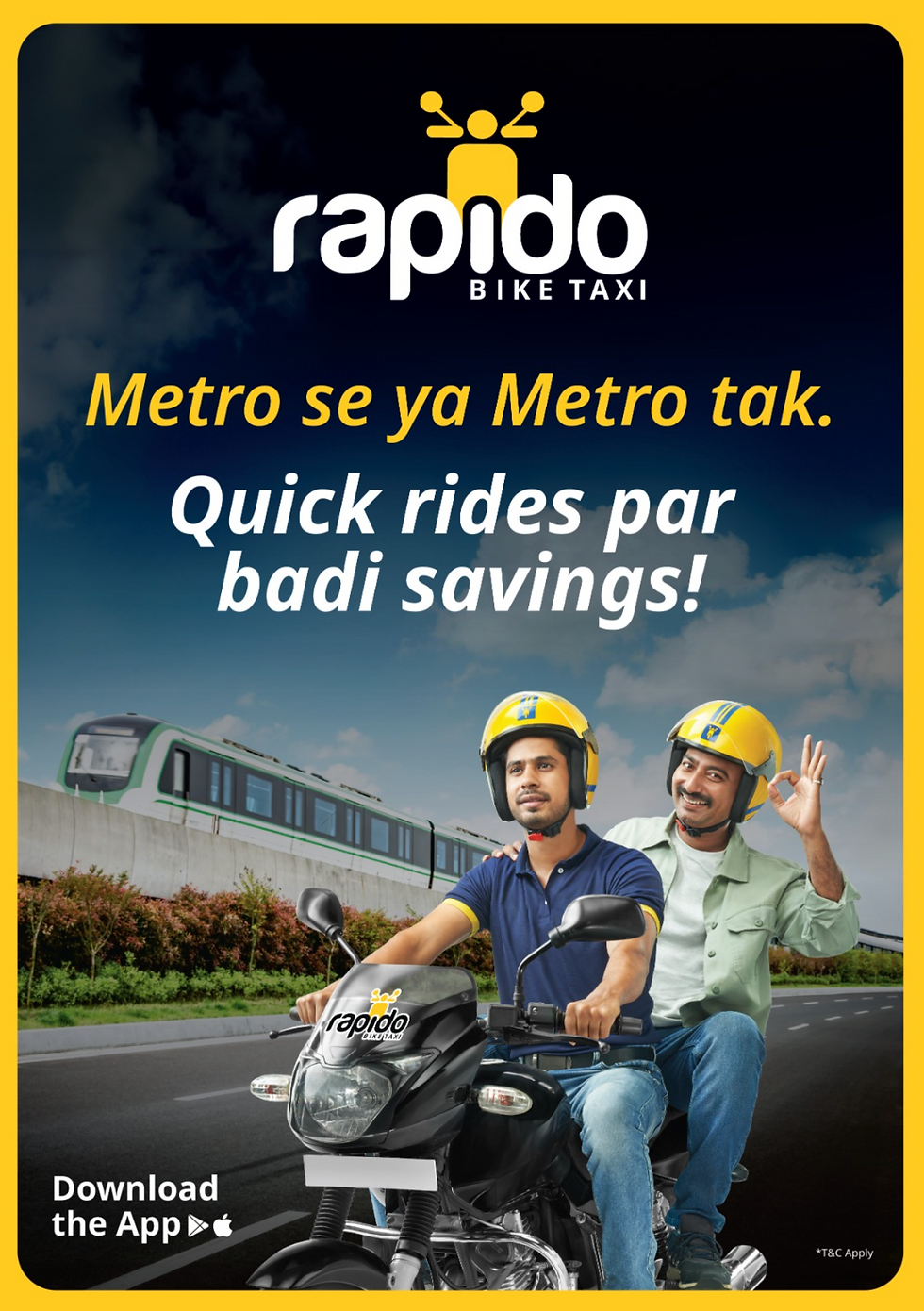
Metro Rapido hoardings- reinforces WoM for consideration and doesn’t act as a primary source for consideration of BT to/from Metro
iii) Commuters experience discomfort in the pick-up experience because of the following reasons:
From Metro:-
Inability to enter Metro gate location accurately - prior to reaching the actual location.
Communicating with the Captain to the metro location spot
Identifying captains in the crowd and reaching the captain
To Metro:-
Even if there are gate location inaccuracies, it can be corrected by asking the captain to drop at the preferred location at the metro
Easy to book a ride from home as people continue their morning chores while booking.

iv) PowerPass in the context of metro users is seen to take two meanings as follows:
A special pass which entails multiple benefits such as discounts, avoid surges etc.
A one-tap card like Metro card where you recharge your Rapido wallet and take a ride in one-tap when out of Metro station. The booking to payment stage is completed by the Tap-feature.

v) Rapido Metro Hoardings only help in creating Brand awareness and not in increasing App consideration
Users are exposed to N of ads hence making them immune to extensive heaviness of the graphics. This reduces the impact of the Ad to trigger a user to use the app at the Metro station.
However, there are engagement points inside/outside of the metro such as local street food shops and Panwadi shops that results in better brand recognition and engagement (Eg: Vimal Ad had highest brand recall value).
Metro is also evolving a meeting-spot for many commuters hence creating Metro-related communication that would trigger group conversations can be a powerful tool.
vi) If people are considering BT on regular basis (High RPC), then pricing is prioritised. But if BT is used less regularly (Med-Low RPC), then time is prioritised.
Daily commute is always perceived as a ‘cost center’ to a commuter. The savings from commute will translate into short-term or long-term savings.
So, if a user is considering BT on regular basis to/from Metro then pricing becomes priority. These users often multi-app, purchase power pass if prices become too steep.
If a user doesn’t consider BT as a daily affair, then time takes precedence in daily commute resulting in ETA centred choosing of rides. These users multi-app based on ETAs and won’t show app-based loyalty.
Media Gallery


Comments